02Arcade History
Are Claw Machines Rigged? How the Crane Game Decides a Grip
A perfect drop, a firm grab, and the plush toy slides out halfway to the chute. Bad luck, or the machine's settings? Mostly the settings.
- Acc. no.
- TT.2026.16
- Hall
- 02Arcade History
- Catalogued
- Time to read
- 4 min
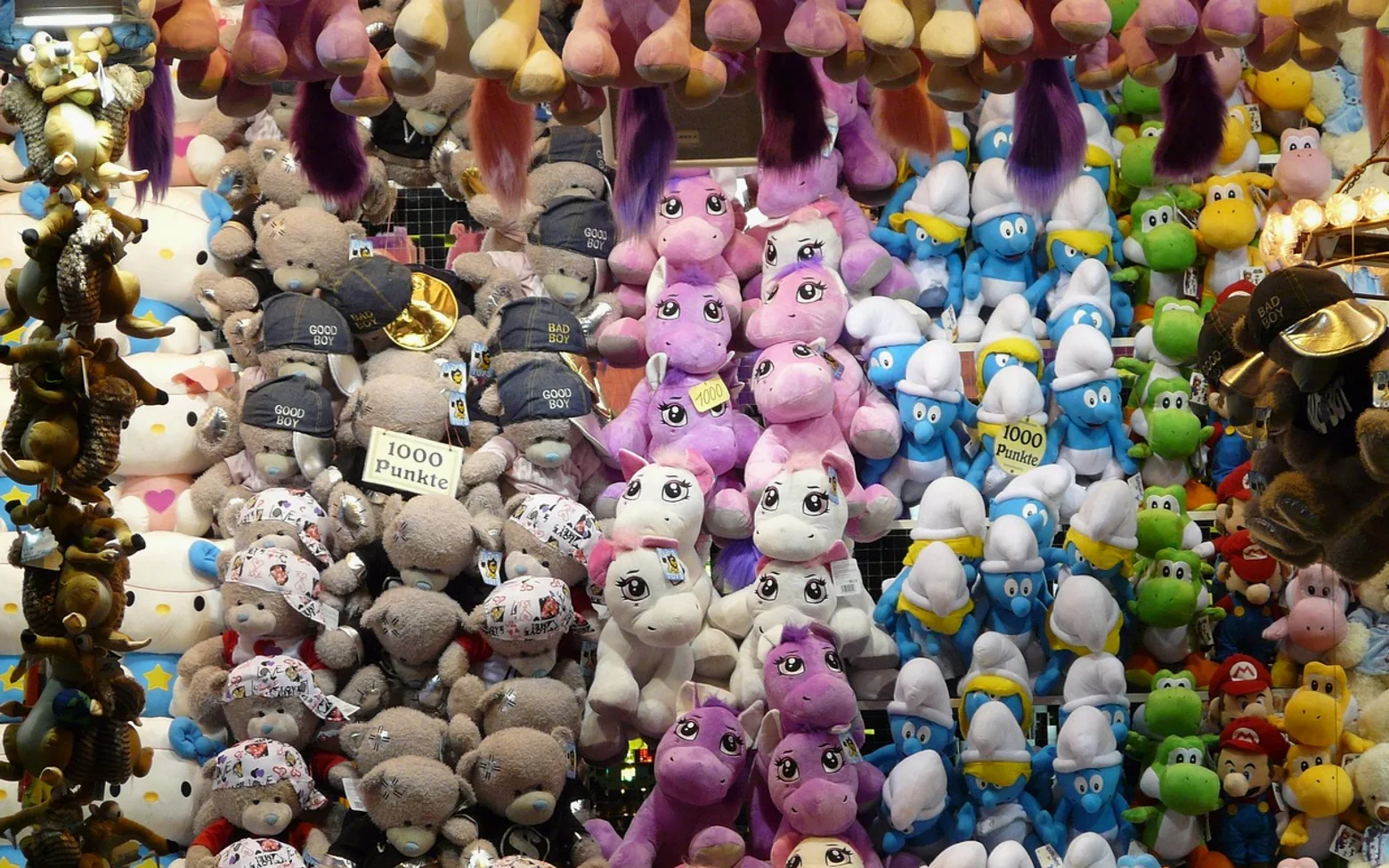
"Rigged" is a strong word, but the honest answer is that most modern claw machines are configured so the claw does not grab at full strength every time. Operators can usually adjust grip strength and, on many machines, how often a full-strength grab is allowed. Skill still matters for lining the claw up, yet the cabinet's settings decide a large share of whether a well-aimed grab actually holds. In many places this is perfectly legal, and in some it is regulated.
How a crane game works
A claw machine is a glass cabinet with a gantry above a heap of prizes. You pay for a credit, steer the claw with a joystick or buttons, usually against a countdown, then drop it. The claw closes, rises and carries whatever it holds towards the prize chute.
Inside, a control board manages several things the player never sees:
- Grip strength: how firmly the claw closes, often set separately for the pick-up and for the carry back to the chute.
- Payout setting: on many machines, a target number of plays per prize. The board delivers a strong grab once that target is reached and a weaker one the rest of the time.
- Drop depth and timing: how far the claw descends and how long it pauses before closing.
- Play timer: the seconds you have to position the claw.
So is it skill or chance?
A blend of both, and the balance depends on the settings. Aim decides whether the claw lands somewhere a prize can be held at all. When the machine only allows a full grip now and then, a perfectly aimed drop on a weak-grip turn can still end with the prize slipping free on the way up. That is why the same player can watch an identical grab succeed one moment and fail the next.
| What the player controls | What the machine controls |
|---|---|
| Position of the claw over the prize | How hard the claw squeezes |
| Choice of prize | How often a full grip is allowed |
| Timing of the drop | How long the grip lasts during the carry |
| How many credits to spend | How the prizes are stacked and spaced |
Where the claw came from
Crane machines date back to the early twentieth century in the United States, when "digger" cabinets stocked with sweets and trinkets appeared at fairs and penny arcades. Because they handed out prizes for coins, they drew the same official attention as early slot machines, and some places restricted them. The format found a second life in Japan, where large, brightly lit crane cabinets became a fixture of game centres from the 1980s and later spread back around the world. Today they sit in arcades, cinemas, supermarkets and bowling alleys, often beside coin pushers and penny falls.
Claw machines and gambling rules
Whether a crane counts as a game of skill, a simple amusement or something closer to gambling depends on local law. Some places limit the value of prizes, expect a minimum win rate or require operators to disclose settings. Others leave it largely to the operator. The pull resembles a slot in one respect: a near miss, the prize lifted and then dropped, feels like progress even when the machine was set to let go. Japan's arcade culture took the same prize-for-play idea in another direction with pachinko parlours.
Practical tips for a better shot
None of these beat a weak-grip setting, but they help when a strong grab is on offer:
- Watch a few turns by other players to see how the claw behaves.
- Pick prizes that sit loose, upright and close to the chute, not wedged under others.
- Check the claw's position from the side as well as the front; depth is where most misses happen.
- Aim for the body or heaviest end of a plush toy, not a narrow tag or limb.
- Decide on a number of plays before you start. If the prize costs more in credits than it would in a shop, the fun was the point all along.
Quick answers
Can you tell when a claw is "due" to grip?
Not reliably. Even where a payout setting exists, you cannot see its target or how many plays have gone in since the last win.
Why do some claws feel weaker than others?
Prize values, rents and running costs shape how operators configure their cabinets. There is no single standard, so two machines side by side can behave very differently.
Was there ever a time when arcade games were banned outright?
Yes. Before flippers arrived, pinball faced the same questions about chance and prizes, and several cities banned it for decades; the story of the pinball bans tells it.
This magazine writes for adults, and prize machines that pay out cash or valuable goods can fall under gambling law where you live, so check the local position. Settle on a number of credits before the first play and keep to it.
Constants of the cabinet
Fixed points behind every game
Whatever the theme, the lights or the feature list, these stay the same.
Results come from a random number generator and each spin stands alone.
The operator keeps a share of stakes over time; that is how the games are funded.
No feature, time of day or betting pattern turns play into income.
The info screen of the version you see is the only reliable source for its settings.
Every gambling game on these pages is for adults aged 18 and over.
Turbo and autoplay change how fast a budget is used, never the odds behind each spin.
Something to add?
Corrections are always welcome.