02Arcade History
Why Was Pinball Banned? The Flipper Game’s Gambling Years
For more than three decades, New York treated pinball like a slot machine. The reasons go back to a time when the game had no flippers at all.
- Acc. no.
- TT.2026.18
- Hall
- 02Arcade History
- Catalogued
- Time to read
- 4 min
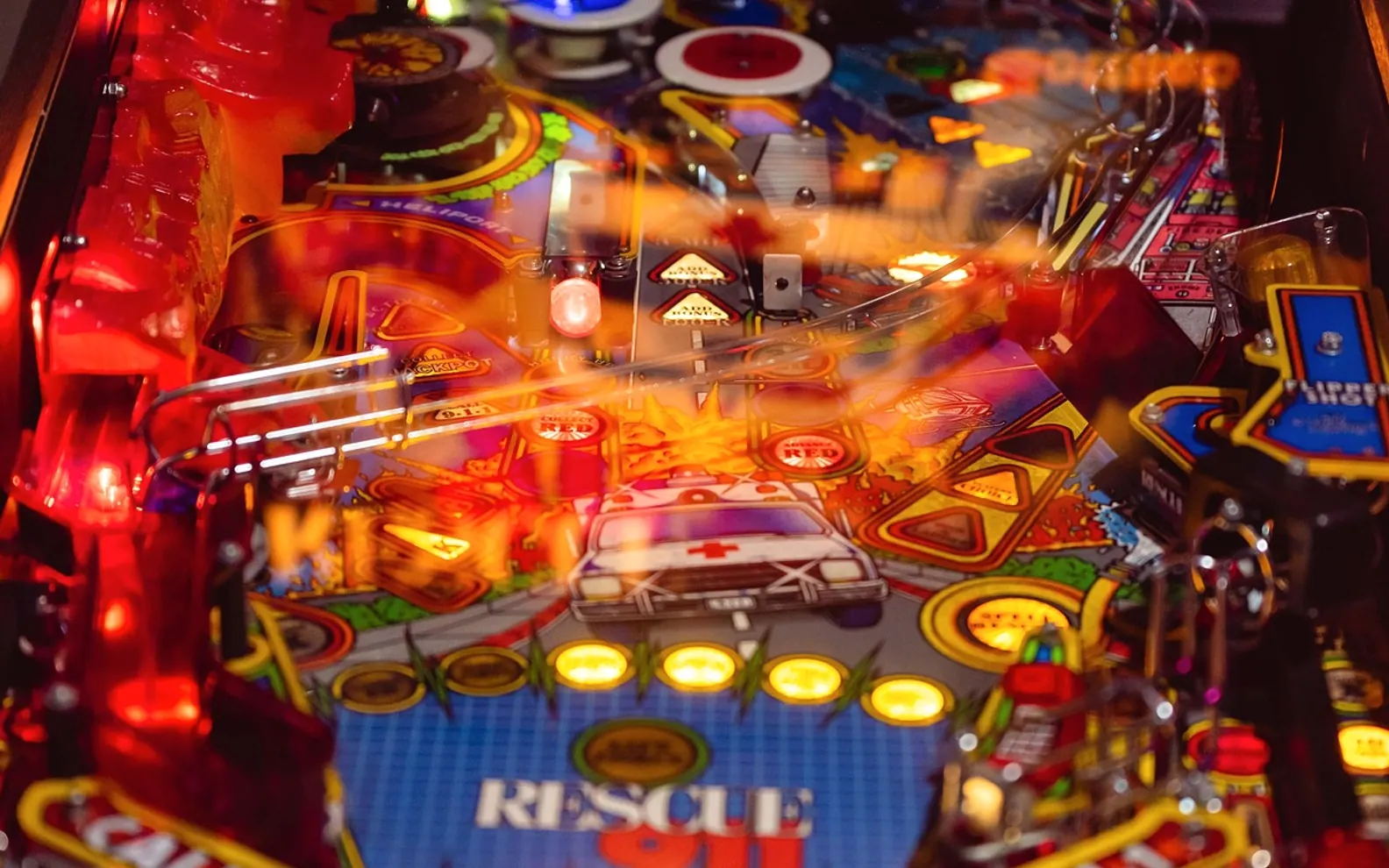
Pinball was banned in several American cities, New York most famously, because officials regarded it as a gambling device. Early machines had no flippers, so a ball's path was mostly luck, and many cabinets paid out prizes or free games that could be traded for cash. New York's ban began in 1942 and lasted until 1976, when a public demonstration of skill helped persuade city lawmakers that modern pinball was a game of ability rather than chance.
Pinball before flippers
The game grew out of bagatelle, a parlour pastime in which balls were struck up a sloping board studded with pins. In the early 1930s, coin-operated versions spread through bars, drugstores and sweet shops across the United States. Titles such as Baffle Ball and Ballyhoo were small, cheap and enormously popular in the Depression years; Ballyhoo even gave its name to the Bally company.
These machines had a plunger and nothing else. Once the ball was launched, the player could only watch it rattle through the pins and into scoring holes. Some players nudged or lifted the cabinet to steer it, which led makers to add the tilt mechanism that ends a game when the machine is handled too roughly.
Payouts and the gambling problem
Operators soon bolted on payout features. Some machines dispensed coins directly. Others awarded free games or tokens, which shopkeepers often exchanged for money behind the counter. To lawmakers, a coin-operated cabinet with an uncertain outcome and a prize looked very much like a slot machine, a device many cities were already trying to remove. Worries about children spending their lunch money and about organised crime controlling vending routes added to the pressure.
A timeline of the bans
| When | What happened |
|---|---|
| Early 1930s | Coin-operated pinball spreads through American shops and bars |
| 1930s to 1940s | Several cities, among them Chicago, Los Angeles and New York, restrict or ban the machines |
| 1942 | New York City bans pinball; Mayor Fiorello La Guardia is photographed smashing confiscated machines |
| 1947 | Flippers appear on Gottlieb's Humpty Dumpty, giving players real control of the ball |
| 1976 | New York lifts its ban after a hearing on whether pinball is a game of skill |
The shot that changed the law
At the 1976 hearing, a writer and pinball enthusiast named Roger Sharpe was asked to prove that the game took skill. He played a machine in front of city council members, called his shot by pointing to the lane he would hit, and made it. The tale is often told as the moment the ban fell, and while the decision rested on more than one shot, it captures the argument neatly: with flippers, a good player could send the ball where they intended.
Flippers changed everything
The flipper turned a luck box into a test of reflexes. Players could trap the ball, aim for ramps and targets, and keep a game alive far longer. Manufacturers leaned on that difference to separate amusement pinball from gambling, while the payout features moved into a separate family of flipperless "bingo" machines that kept the old prize logic for years.
The skill argument has only grown stronger since. Pinball now has leagues, ranked tournaments and players who study individual machines the way chess players study openings, all of it built on the flipper's simple promise of control.
Echoes in today's games
- Pachinko is a vertical cousin of pre-flipper pinball, with balls falling through pins; see how pachinko works.
- Prize machines such as coin pushers and claw machines still raise the old question of skill versus chance.
- Slot machines took the opposite route, embracing chance openly and moving into regulated venues; their story is traced in the evolution of slot machines.
Quick answers
Is pinball gambling today?
Standard amusement pinball, played for score and free replays, is generally treated as a game of skill. Machines that pay money or valuable prizes are a different matter and fall under local gambling rules.
Why does pinball have a tilt?
Tilt was added in the flipperless era to stop players shaking or lifting the cabinet to steer the ball. It survives as part of the skill: a little nudging is allowed, too much ends the ball.
Were other games caught up in the same bans?
Coin-operated prize games of many kinds, from early slot machines to crane "diggers", drew similar scrutiny in the same decades. Whether a game rewarded skill or luck was the question every time.
The history makes for a good story, but any game played for money or valuable prizes is for adults only and subject to local law, so check the rules where you are before playing anything with a payout attached.
Constants of the cabinet
Fixed points behind every game
Whatever the theme, the lights or the feature list, these stay the same.
Results come from a random number generator and each spin stands alone.
The operator keeps a share of stakes over time; that is how the games are funded.
No feature, time of day or betting pattern turns play into income.
The info screen of the version you see is the only reliable source for its settings.
Every gambling game on these pages is for adults aged 18 and over.
Turbo and autoplay change how fast a budget is used, never the odds behind each spin.
Something to add?
Corrections are always welcome.